SonarQube Debt Ratio Vs Dollar Carrying Cost Explained
SonarQube Debt Ratio Vs Dollar Carrying Cost Explained — a focused guide for tech leads: what to do, what to measure, and what to avoid so this work stays separate from adjacent efforts.
Side-by-side criteria for this choice
SonarQube Debt Ratio Vs Dollar Carrying Cost Explained is a buy/build/borrow decision. Score accuracy, maintenance, privacy, and auditability — not just license cost. A spreadsheet is free until it costs an hour a week and no one trusts the numbers.
| Criterion | Option A | Option B |
|---|---|---|
| Accuracy | Medium, manual | High, audited |
| Maintenance | ~1h/week | Near zero |
| Privacy | Local file | Check upload |
| History | None | Trend + audit |
Compare with real numbers.
Try the calculatorVerdict by team size
Under ~10 devs: start manual, timebox maintenance. 10–50: switch when rework or audit needs exceed spreadsheet trust — typically when SonarQube debt ratio vs dollar carrying touches incidents or budgets. 50+: use a queryable ledger with history; wikis and labels do not survive personnel change. See tracking complements and valuation math for inputs.
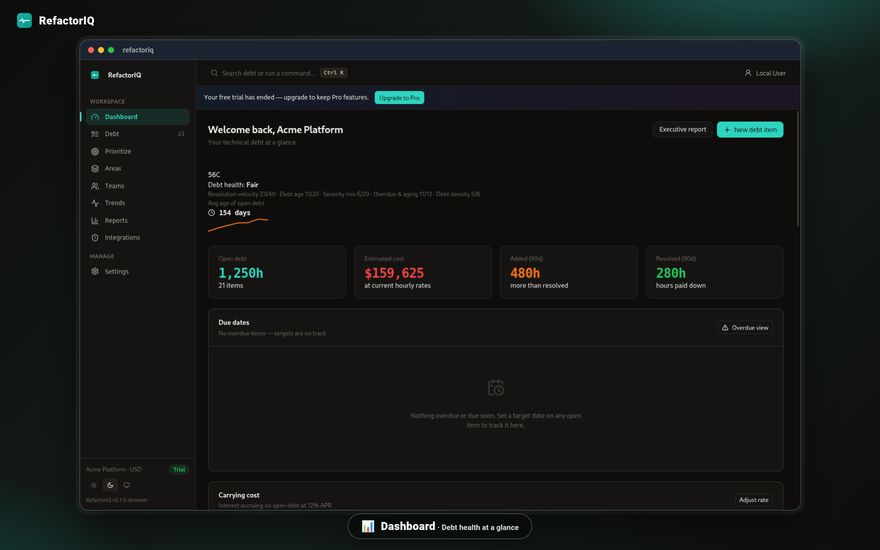
Migration path that sticks
- Import: top 20 items with hours, rate, APR in one CSV.
- Parallel run: two weeks dual-entry, then cut over.
- Retire: freeze the old sheet, link it once, archive.
Import once, report forever — offline.
Download RefactorIQWhat comparisons do not do
Comparisons choose tooling; they do not teach single-tool operation, define debt from scratch, or run ceremonies. Pick the tool here — learn it in its own guide.
Worked example: pricing this in dollars per day
The choice is not technical, it is economic. Take one item from this guide and price it the way the calculator on the product page does it:
principal = hours × blended rate
daily carrying cost = principal × APR ÷ 365
| Input | Value | What it tells you |
|---|---|---|
| Effort to fix | 12 h | Your estimate of the work, not the wish |
| Blended rate | $95/h | Loaded cost, not salary |
| Principal | $1,140 | The value sitting in the code |
| APR | 8% | Drag: slower changes, bugs, onboarding tax |
| Daily carry | ~$0.25/day | What waiting costs today |
| Yearly carry | ~$91/yr | What waiting costs for twelve months |
Run the same row twice before you believe it. Halve the hours and the carry still lands near $46 a year; double them and it is ~$182. Knowing which end of that range you are on is what lets you promise a date instead of a hope.
One quarter of drift on this item costs about $23. That figure is the whole argument — it is small enough to be ignored in a roadmap review and large enough to matter once it compounds across a backlog.
What this guide does not cover
This post stays narrow on purpose. It does not go into single-tool how-to, generic debt definition, or unrelated sprint ceremony guide, because those are separate decisions with their own inputs and their own audience. If you are weighing sonarQube Debt Ratio Vs Dollar Carrying Cost Explained specifically, read this alongside Linear Vs Jira For Tracking Refactoring Work Comparison rather than trying to stretch either one to cover the other.
Key takeaways
- Price it before you argue about it. 12 hours at $95/h is $1,140 of principal; the debate about whether it matters stops being subjective once the number exists.
- Carry compounds quietly. ~$0.25 a day and ~$91 a year for this item, and it costs nothing to keep paying it.
- Name an owner and a date. Debt without a trigger is a wish; debt with a trigger becomes a line item.
- Show the range. Halve the estimate and the number still holds. If it does not, the estimate needs work, not the argument.
- Next step. Bring the range to planning so the estimate is argued, not assumed.
FAQ
SonarQube debt ratio vs dollar carrying: which is better for scale-ups?
Start with sonarQube Debt Ratio Vs Dollar Carrying Cost Explained: about 12 hours of work at a blended $95/h, or $1,140 of principal carrying roughly $0.25 a day. State that number, then the single business outcome it protects, then ask for dated capacity. If the ask is declined, log it with a revisit trigger so the decision stays visible to the tech lead.
What are limitations of SonarQube debt ratio vs dollar carrying?
Start with sonarQube Debt Ratio Vs Dollar Carrying Cost Explained: about 12 hours of work at a blended $95/h, or $1,140 of principal carrying roughly $0.25 a day. State that number, then the single business outcome it protects, then ask for dated capacity. If the ask is declined, log it with a revisit trigger so the decision stays visible to the tech lead.
When to switch for SonarQube debt ratio vs dollar carrying?
Act once the carry compounds faster than the cost of waiting. On a $1,140 item that is $0.25 per day, so a single quarter of drift costs about $23 and a full year about $91. If the work touches code you change every sprint, that is already your trigger.