7 Best Jira Alternatives for Teams Tired of Ticket Bloat (2026)
Jira isn't bad — it's heavy. Here are seven lighter, faster, or more focused alternatives, plus the one debt question none of them answer.
Why teams look for Jira alternatives
Almost nobody leaves Jira because it can't track work. Teams leave because the cost of tracking exceeds the value: slow boards with 5,000 stale tickets, workflows that need an admin to change a status, per-seat pricing that punishes growing teams, and notifications nobody reads.
The pattern we see in technical debt backlogs is the same: 20–30% of open Jira issues are debt that was logged, never priced, and never scheduled. They sit in "Backlog" for two years, get bulk-moved every quarter, and quietly accrue carrying cost while the team pays full price for every seat that can see them.
If that sounds familiar, a new tracker alone won't save you. But the right tracker — paired with a way to price what you track — will.
What to look for in an alternative
Ignore feature checklists. Grade tools on four things:
- Speed of capture: can a dev log debt in under 30 seconds, or does it need six required fields? Slow capture means debt never gets logged.
- Signal vs noise: does ranking come from priority math you can explain, or from whoever shouts loudest in grooming? Look for tunable scoring, not just drag-and-drop.
- Cost model: per-seat SaaS punishes transparency — every stakeholder you add costs money. Self-hosted or flat-priced tools win for debt inventories everyone should see.
- Exit path: CSV export, API access, and a read-only freeze plan. If you can't leave in an afternoon, you don't own your backlog.
And ask one question vendors hate: "how does this tell me what waiting costs in dollars per day?" If the answer is a plugin, a dashboard, or silence, keep reading.
The 7 best Jira alternatives in 2026
1. Linear — best for software teams that want speed
Linear is what Jira would be if it started in 2020: keyboard-first, instant search, cycles instead of ceremony. Triage is fast enough that debt actually gets logged. Weakness: reporting is opinionated — great for shipping, thin for proving ROI to a CFO. Best for teams of 3–50 who live in GitHub and hate admin.
2. ClickUp — best all-in-one customizer
ClickUp replaces Jira plus docs plus goals plus time tracking, with views for every taste. Power comes at a price: it needs governance or it becomes Jira with a new logo — 40 statuses and nobody knows what "In Progress" means. Best for agencies and ops-heavy teams that want one workspace.
3. Asana — best for cross-functional teams
Asana wins where Jira loses non-engineers: design, marketing, and leadership actually open it. Portfolios and goals are clearer than Jira Advanced Roadmaps for most mortals. Weakness: sprints and code integrations feel bolted on. Best when debt needs business context, not just dev tickets.
4. monday.com — best for visual workflows
monday is a spreadsheet that grew up: boards, automations, and dashboards without an admin certification. Non-technical stakeholders adopt it fast. Weakness: software-specific workflows (branches, releases, Git links) are shallow compared to Jira or Linear. Best for product-plus-business backlogs.
5. YouTrack — best self-hosted JetBrains option
YouTrack gives you agile boards plus a query language that actually scales ("#Unresolved #Backend sort by votes"), with self-hosting if data can't leave your network. The UI shows its age, but keyboard search and time tracking are solid. Best for JetBrains shops and privacy-sensitive teams.
6. OpenProject — best open-source alternative
OpenProject is the honest open-source pick: Gantt, boards, wikis, and time tracking, self-hosted under GPL. You trade polish for control — no per-seat meter, full data ownership, community plugins. Best for public-sector, EU-regulated, or budget-capped teams that must self-host.
7. RefactorIQ — best complement for pricing technical debt
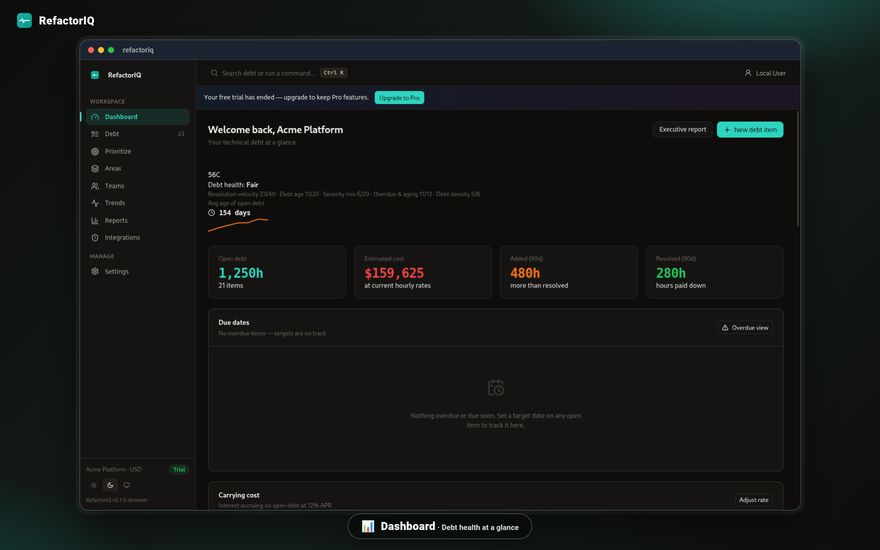
RefactorIQ isn't another sprint tracker — it's what sits next to one. Import or re-enter debt items, estimate optimistic / likely / pessimistic hours, and it prices each item: principal = hours × rate, daily burn = principal × APR ÷ 365. Then it ranks everything 0–100 and builds a 30/60/90-day payoff plan against real capacity.
It runs fully offline on Windows and Linux, stores everything in local SQLite, and never charges per seat. Use it when your question isn't "who's doing what this sprint?" but "what does waiting cost, what do we fix first, and what did we save?" Try the 30-second calculator — same math as the app.
Price one debt item in 30 seconds — same formula the app uses.
Try the debt calculatorAt a glance
| Tool | Best for | Hosting | Watch out |
|---|---|---|---|
| Linear | Fast software teams | Cloud | Thin exec reporting |
| ClickUp | All-in-one customization | Cloud | Needs governance |
| Asana | Cross-functional work | Cloud | Weak dev workflows |
| monday.com | Visual project tracking | Cloud | Shallow code links |
| YouTrack | Self-hosted control | Cloud / self-hosted | Dated UI |
| OpenProject | Open-source, self-hosted | Self-hosted / cloud | Less polish |
| RefactorIQ | Pricing and paying down debt | Local desktop (offline) | Not a sprint tracker |
The gap none of them fix: debt value
Here's the uncomfortable truth: Linear, ClickUp, Asana, monday, YouTrack, and OpenProject all track tickets. None of them track debt value. They can't tell you that auth.ts:142 TODO since 2021 costs ~$0.32/day at 12% APR, or that your 25-item backlog burns ~$4.93/day — ~$1,800/year if untouched. For the full math, see how to calculate debt cost in $/day.
That gap is why migrations disappoint. Teams move 3,000 tickets to a faster tool and import the same unpriced, unranked debt — now with nicer animations. A tracker answers "who's doing what?" Debt economics answers "what should we do first, what does waiting cost, and what did fixing it save?" You need both.
How to use RefactorIQ with Jira (or without it)
Don't rip out Jira on day one. Run this loop for one quarter:
- Keep sprints where they are. Jira or Linear still owns "who's doing what this week."
- Price debt separately. Export candidate debt to CSV, import the real items into RefactorIQ, estimate hours, set your rate and APR. Sort by daily burn and 0–100 score.
- Schedule by savings. Take the top slice that fits weekly capacity into a 30/60/90-day plan. "This sprint saves ~$540/year" funds the next one.
- Migrate only what survives. When you do switch trackers, move open, priced items only. Close, merge, or archive the rest — freezing the old project read-only for 90 days beats importing 5,000 dead tickets.
When to keep Jira? Regulated enterprises with audit-heavy workflows, Advanced Roadmaps power users, and teams with a dedicated Jira admin who actually likes the job. Everyone else: pick the tracker your team will open daily, and price debt where pricing belongs.
Skip the spreadsheet — track it for real. Free Demo, 15-day Pro trial, no account.
Download RefactorIQFAQ
What is the best alternative to Jira in 2026?
For software teams that want speed: Linear. For all-in-one customization: ClickUp. For non-technical teams: Asana or monday. For self-hosted control: YouTrack or OpenProject. There is no single best — match the tool to team size and workflow.
Should I replace Jira to manage technical debt?
Switching trackers rarely fixes debt. Jira, Linear, and ClickUp track tickets, not debt value — none price hours × rate or carrying cost in $/day. Keep your tracker for sprints and price debt separately.
Can I use RefactorIQ alongside Jira?
Yes — that is the intended setup. Track sprints in Jira, then price, rank, and plan the debt payoff in RefactorIQ: hours × rate for principal, principal × APR ÷ 365 for daily burn, plus a 0–100 priority score and 30/60/90-day plan.
How do I migrate off Jira without losing history?
Export CSV, freeze the old project read-only for 90 days, migrate open issues only, and re-triage on import. Most teams discover 20–30% of imported tickets are stale debt that should be closed, merged, or priced — not migrated.