How to Calculate Technical Debt Cost in $/Day
Story points don't pay invoices. Here is the two-line math that turns any debt item into dollars per day — then what to do with the number.
The formula is two lines
Forget complex models. Price debt like a loan:
principal = estimated hours × team hourly rate
daily carrying cost = principal × APR ÷ 365
Two inputs, one division. Everything below is just how to pick honest inputs. New to the concept? Start with the 101 guide to what technical debt is, then come back with a calculator.
Step 1: the principal (hours × rate)
The principal is what it would cost to fix the item today. Estimate three numbers — optimistic, likely, pessimistic hours — and price the likely case. The spread becomes your range, which you will show next to every figure.
For the rate, use a blended hourly figure: salary plus overhead for the people who would actually do the work. $75/h is a common blended figure for senior-heavy teams; $80–120/h fits teams with heavy benefits or contractor load. Use your own — but write it down, because every number downstream inherits it.
Step 2: pick an APR
The APR models drag: slower changes, bugs, onboarding tax, incident risk. It is the only subjective input, so keep it visible and tunable. Start here:
| Area | APR | Why |
|---|---|---|
| Stable internal tooling | 5–8% | Rarely touched, low blast radius |
| Typical product code | 10–15% | Default 12% lives here |
| Incident-prone or customer-facing | 20–25%+ | Waiting risks outages, churn, or security exposure |
One rule: always show the APR next to the number. "$0.32/day at 12% APR" invites an argument about inputs; "$0.32/day" invites an argument about vibes.
Worked example: one TODO, priced
Take the classic specimen: auth.ts:142 TODO since 2021. Likely fix: 12 hours. Blended rate: $80/h.
- Principal: 12 × $80 = $960
- Daily burn: $960 × 0.12 ÷ 365 = ~$0.32/day
- Yearly carry if untouched: ~$115/yr
That TODO costs about a coffee a week, every week, forever — until someone spends the $960 to kill it. Now do that for every item and sort by burn.
Run your own numbers with the same formula — 30 seconds, nothing leaves your browser.
Price your debt in 30sRoll it up: the whole backlog in $/day
Sum the principals, apply one APR (or per-area APRs if you tuned them), divide by 365. Using the portfolio from the 101 guide — 25 items averaging 8 hours at $75/h:
- Total principal: 25 × 8 × $75 = ~$15,000
- Daily burn: $15,000 × 0.12 ÷ 365 = ~$4.93/day
- Yearly carry: ~$1,800/yr
- Fixing the top 30% saves roughly ~$540/yr — every year.
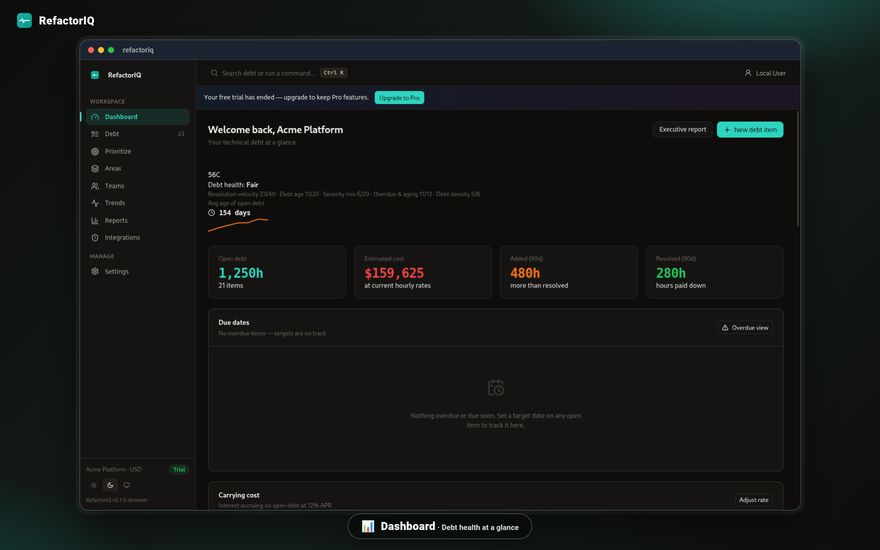
What to do with the number
A $/day figure earns its keep three ways. Rank: sort items by daily burn and fix the hottest ones first — or pair the number with the 0–100 scoring method from the payoff loop when burn alone doesn't capture risk. Negotiate: "this sprint saves $540/yr" funds refactoring; "the code is messy" doesn't. Track: re-price weekly and watch the portfolio burn fall — that downward slope is your ROI chart.
Next step: run the team per-day formula with spreadsheet inputs and roll the portfolio to an annual burn rate for the budget conversation.
What the number is not
It is not an invoice and not a promise. It is an estimate with a visible range, built on two assumptions (rate, APR) you can defend or adjust. Show the ~, show the range, revisit the inputs quarterly — and never let a $/day figure overrule a production incident. Math informs judgment; it doesn't replace it.
Skip the spreadsheet — track it for real. Free Demo, 15-day Pro trial, no account.
Download RefactorIQFAQ
What is the formula for technical debt cost?
Principal = estimated hours × team hourly rate; daily carrying cost = principal × APR ÷ 365 (default 12%). A $960 item burns ≈ $0.32/day, ≈ $115/year. Try it on the debt calculator.
What APR should I use for technical debt?
Start at 12%. Use 5–8% for stable internal tooling, 10–15% for typical product code, and 20–25%+ for incident-prone, customer-facing, or security-adjacent debt. Always show the APR next to the number.
Should I estimate technical debt in hours or story points?
Hours. Dollars need hours × rate, and story points don't convert — they vary by team and sprint. Estimate optimistic/likely/pessimistic hours and price the likely case.
How accurate is a dollars-per-day debt figure?
It is an estimate with a range: precise enough to rank items and negotiate budget, never an invoice. Always show ~ with the range and revisit the inputs quarterly.