Strangler Fig Vs Branch By Abstraction Monolith Guide
Strangler Fig Vs Branch By Abstraction Monolith Guide — a focused guide for ctos: what to do, what to measure, and what to avoid so this work stays separate from adjacent efforts.
How to detect this debt
Strangler Fig Vs Branch By Abstraction Monolith Guide starts with a query, not an opinion. Run the detector weekly: dependency age, duplication, coupling, or schema sprawl depending on the area. Record hits with file, age, and blast radius. Primer: debt basics and prevention habits.
Stepwise remediation with rollback
Isolate first, then shrink: add a seam or anti-corruption layer, migrate one slice behind a flag, keep the old path until monitors stay quiet for one release, then delete. Example slice for this case: ~14h of focused work at $75/h scope, one bounded context at a time. Never big-bang without a rehearsed revert.
| Gate | Check | Tool |
|---|---|---|
| Detect | Weekly query | Scanner + review |
| Isolate | Seam/flag | Tests green |
| Remove | Old path deleted | Monitors quiet |
See hygiene tracking in the tour.
See product tourConcrete slice for this case
Pick the smallest independently shippable slice of strangler fig vs branch by abstraction, characterize it with tests, migrate behind a flag with shadow or canary traffic, and delete the old path only after the gate passes. Document the decision in one ADR: context, options, slice order, and rollback command.
Preventing return
- Fitness function: fail the build on new violations of this rule.
- Review checklist: one line for this hygiene area in every PR template.
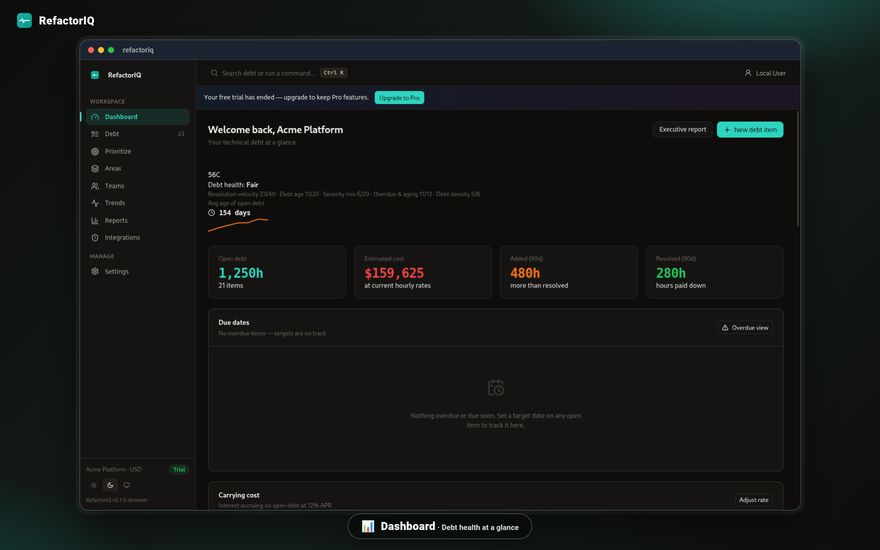
Track hygiene locally. Free Demo, no account.
Download RefactorIQWhat hygiene work does not do
Hygiene fixes structure; it does not set dollar budgets, run sprint ceremonies, or measure morale. Ship the structural fix here — hand valuation and team health to their own reviews.
Worked example: pricing this in dollars per day
The choice is not technical, it is economic. Take one item from this guide and price it the way the calculator on the product page does it:
principal = hours × blended rate
daily carrying cost = principal × APR ÷ 365
| Input | Value | What it tells you |
|---|---|---|
| Effort to fix | 14 h | Your estimate of the work, not the wish |
| Blended rate | $75/h | Loaded cost, not salary |
| Principal | $1,050 | The value sitting in the code |
| APR | 12% | Drag: slower changes, bugs, onboarding tax |
| Daily carry | ~$0.35/day | What waiting costs today |
| Yearly carry | ~$126/yr | What waiting costs for twelve months |
Run the same row twice before you believe it. Halve the hours and the carry still lands near $63 a year; double them and it is ~$252. That spread is a risk signal: if the range spans an order of magnitude, the estimate needs work before it can carry a decision.
One quarter of drift on this item costs about $32. That figure is the whole argument — it is small enough to be ignored in a roadmap review and large enough to matter once it compounds across a backlog.
What this guide does not cover
This post stays narrow on purpose. It does not go into sprint scoring politics, CFO dollar framing, or team burnout surveys, because those are separate decisions with their own inputs and their own audience. If you are weighing strangler Fig Vs Branch By Abstraction Monolith Guide specifically, read this alongside Database Migration Zero-Downtime Legacy Postgres Example rather than trying to stretch either one to cover the other.
Key takeaways
- Price it before you argue about it. 14 hours at $75/h is $1,050 of principal; the debate about whether it matters stops being subjective once the number exists.
- Carry compounds quietly. ~$0.35 a day and ~$126 a year for this item, and it costs nothing to keep paying it.
- Name an owner and a date. Debt without a trigger is a wish; debt with a trigger becomes a line item.
- Show the range. Halve the estimate and the number still holds. If it does not, the estimate needs work, not the argument.
- Next step. Treat the range as a risk input when you sequence platform work.
FAQ
How to detect strangler fig vs branch by abstraction early?
Start with strangler Fig Vs Branch By Abstraction Monolith Guide: about 14 hours of work at a blended $75/h, or $1,050 of principal carrying roughly $0.35 a day. State that number, then the single business outcome it protects, then ask for dated capacity. If the ask is declined, log it with a revisit trigger so the decision stays visible to the cto.
What is the safest migration path for strangler fig vs branch by abstraction?
Start with strangler Fig Vs Branch By Abstraction Monolith Guide: about 14 hours of work at a blended $75/h, or $1,050 of principal carrying roughly $0.35 a day. State that number, then the single business outcome it protects, then ask for dated capacity. If the ask is declined, log it with a revisit trigger so the decision stays visible to the cto.
What tools measure strangler fig vs branch by abstraction?
You need three capabilities, not one product: detection, an estimate in hours, and a cost in dollars per day. Static analysers handle the first well and the third badly. For a $1,050 item the gap is the difference between "this smells" and "$126 a year to carry".