Skip-Level Meeting Questions Surfacing Hidden Tech Debt
Skip-Level Meeting Questions Surfacing Hidden Tech Debt — a focused guide for vp of engineerings: what to do, what to measure, and what to avoid so this work stays separate from adjacent efforts.
Metric definition for this signal
Skip-Level Meeting Questions Surfacing Hidden Tech Debt earns a place on the leadership dashboard when it has a definition, a target, and a decision. Define numerator/denominator, window (weekly for flow, quarterly for health), and owner. Without those three, it is trivia.
Benchmarks and board chart
Show trend plus benchmark band: last 12 weeks, peer range, and threshold. Example: if skip-level meeting questions surfacing hidden tech degrades two quarters while change-failure rises, the chart should make the capacity ask obvious. Pair with one outcome (incident, churn, or delay) — never a metric alone. Context: thresholds.
| Field | This quarter | Target |
|---|---|---|
| Signal | Trend ↓/→/↑ | Band |
| Outcome link | Incident/churn | — |
| Decision | Capacity % | Date |
See leadership reporting in the tour.
See reporting60-second board narrative
“skip-level meeting questions surfacing hidden tech moved X → Y this quarter against a target band of Z. That correlates with [outcome]. We request N% capacity next quarter and will report movement and outcome together.” One chart, one benchmark, one ask — no jargon, no ticket counts.
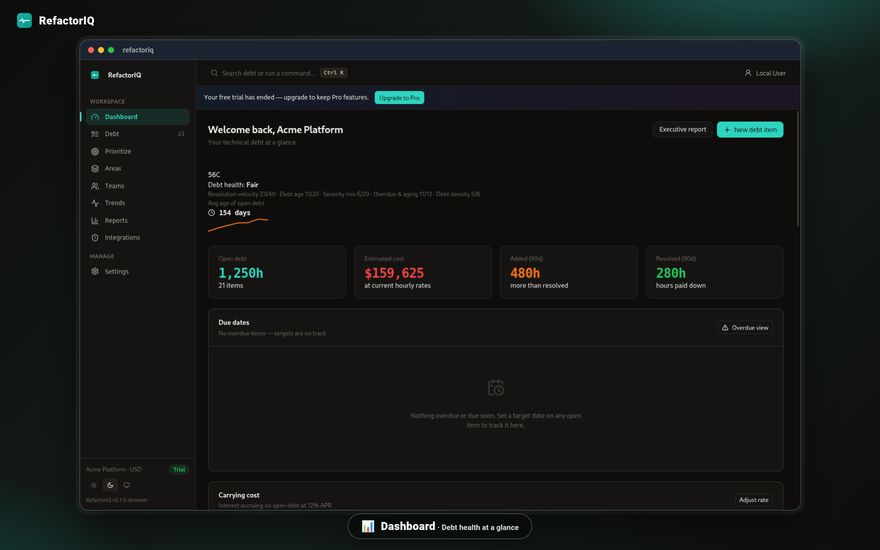
Operating cadence
- Weekly: flow signals for managers.
- Quarterly: health plus outcome for directors and board.
Report outcomes, not output — offline.
Download RefactorIQReport this next to annual engineering effectiveness survey template on the same leadership readout so trend and target stay on one page.
What leadership metrics do not do
Metrics drive allocation; they do not teach estimation math, configure tickets, or rewrite code. Choose the decision here — hand implementation to teams with context.
Worked example: pricing this in dollars per day
The choice is not technical, it is economic. Take one item from this guide and price it the way the calculator on the product page does it:
principal = hours × blended rate
daily carrying cost = principal × APR ÷ 365
| Input | Value | What it tells you |
|---|---|---|
| Effort to fix | 13 h | Your estimate of the work, not the wish |
| Blended rate | $100/h | Loaded cost, not salary |
| Principal | $1,300 | The value sitting in the code |
| APR | 20% | Drag: slower changes, bugs, onboarding tax |
| Daily carry | ~$0.71/day | What waiting costs today |
| Yearly carry | ~$260/yr | What waiting costs for twelve months |
Run the same row twice before you believe it. Halve the hours and the carry still lands near $130 a year; double them and it is ~$520. At portfolio scale those per-item ranges are the difference between a defensible investment and a number nobody in the room trusts.
One quarter of drift on this item costs about $65. That figure is the whole argument — it is small enough to be ignored in a roadmap review and large enough to matter once it compounds across a backlog.
What this guide does not cover
This post stays narrow on purpose. It does not go into PERT calculation tutorials, Jira ticket tactics, or file-level code fixes, because those are separate decisions with their own inputs and their own audience. If you are weighing skip-Level Meeting Questions Surfacing Hidden Tech Debt specifically, read this alongside Parallel Change Expand Contract Pattern Legacy Refactoring Tutorial rather than trying to stretch either one to cover the other.
Key takeaways
- Price it before you argue about it. 13 hours at $100/h is $1,300 of principal; the debate about whether it matters stops being subjective once the number exists.
- Carry compounds quietly. ~$0.71 a day and ~$260 a year for this item, and it costs nothing to keep paying it.
- Name an owner and a date. Debt without a trigger is a wish; debt with a trigger becomes a line item.
- Show the range. Halve the estimate and the number still holds. If it does not, the estimate needs work, not the argument.
- Next step. Roll these up; a portfolio number outlives a single sprint.
FAQ
What good looks like for skip-level meeting questions surfacing hidden tech?
Start with skip-Level Meeting Questions Surfacing Hidden Tech Debt: about 13 hours of work at a blended $100/h, or $1,300 of principal carrying roughly $0.71 a day. State that number, then the single business outcome it protects, then ask for dated capacity. If the ask is declined, log it with a revisit trigger so the decision stays visible to the vp of engineering.
How to report skip-level meeting questions surfacing hidden tech to the board?
Start with skip-Level Meeting Questions Surfacing Hidden Tech Debt: about 13 hours of work at a blended $100/h, or $1,300 of principal carrying roughly $0.71 a day. State that number, then the single business outcome it protects, then ask for dated capacity. If the ask is declined, log it with a revisit trigger so the decision stays visible to the vp of engineering.
How to benchmark skip-level meeting questions surfacing hidden tech vs peers?
Start with skip-Level Meeting Questions Surfacing Hidden Tech Debt: about 13 hours of work at a blended $100/h, or $1,300 of principal carrying roughly $0.71 a day. State that number, then the single business outcome it protects, then ask for dated capacity. If the ask is declined, log it with a revisit trigger so the decision stays visible to the vp of engineering.